WordPress Developer Ukraine, Kyiv
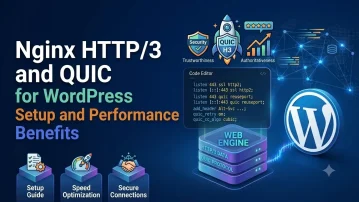
Nginx HTTP/3 and QUIC for WordPress: Setup and Performance Benefits

Nginx HTTP/3 and QUIC for WordPress: Setup and Performance Benefits

HTTP/3 (based on QUIC, RFC 9000) reduces page load time by eliminating TCP head-of-line blocking and reducing connection setup latency — connections over QUIC complete in 0-RTT on repeat visits compared to 1-RTT for TLS 1.3 over TCP. Nginx 1.25+ includes experimental QUIC/HTTP3 support that can be enabled alongside HTTP/2, giving browsers that support QUIC…

Linux Podman for WordPress: Rootless Containers Without Docker

Linux Podman for WordPress: Rootless Containers Without Docker

Podman is a daemonless, rootless container engine that is a drop-in CLI replacement for Docker — podman run accepts the same flags as docker run — but runs containers as an unprivileged user with no background daemon. For WordPress server deployments, rootless Podman containers provide stronger isolation than Docker (no root daemon to compromise) and…
Linux Auditd for WordPress Security: Tracking File and Process Events

Linux Auditd for WordPress Security: Tracking File and Process Events

The Linux Audit daemon (auditd) records file accesses, process executions, and privilege changes at the kernel level — events that application-level logging never captures. For WordPress servers, auditing writes to wp-config.php, executions of PHP in the uploads directory, and su/sudo events gives you a tamper-evident log trail that survives even if the attacker deletes application…
Linux eBPF for WordPress Performance Tracing: bpftrace and BCC

Linux eBPF for WordPress Performance Tracing: bpftrace and BCC

eBPF (extended Berkeley Packet Filter) lets you attach lightweight programs to kernel and userspace tracepoints with zero application code changes. For WordPress performance work, bpftrace and the BCC toolkit can trace every PHP function call, MySQL query, or file I/O event in real time — far more granular than APM tools and without the overhead…
Linux Network Namespaces and WordPress Multi-Site Isolation

Linux Network Namespaces and WordPress Multi-Site Isolation

Linux network namespaces let you run multiple WordPress instances on the same physical server with completely isolated network stacks — each namespace has its own loopback, virtual interfaces, routing table, and iptables rules. Combined with veth pairs and a bridge device, you get per-site firewall policies and the ability to run multiple MySQL instances on…
Linux cgroups v2 and Systemd Slices for PHP-FPM Resource Control

Linux cgroups v2 and Systemd Slices for PHP-FPM Resource Control

On a shared WordPress server running multiple PHP-FPM pools, one pool’s CPU spike or memory leak can starve the others. Linux cgroups v2 — exposed through systemd slices and service limits — lets you assign hard CPU and memory ceilings to each pool so a runaway plugin cannot take the entire server down. This requires…
Linux Kernel Tuning for High-Traffic WordPress: sysctl and TCP Optimisations

Linux Kernel Tuning for High-Traffic WordPress: sysctl and TCP Optimisat ...

The default Linux kernel parameters are tuned conservatively for general workloads. A WordPress server handling thousands of concurrent visitors benefits from a small set of sysctl tweaks: larger TCP buffers, faster TIME_WAIT recycling, increased file-descriptor limits, and a more aggressive vm.swappiness. These changes require no reboot and can be applied live.
Linux OOM Killer and Swap Tuning for WordPress Servers

Linux OOM Killer and Swap Tuning for WordPress Servers

The Linux OOM (Out-Of-Memory) Killer terminates processes when the system runs out of RAM and swap space. On WordPress servers, it typically kills either MySQL or PHP-FPM — causing database corruption or 502 errors. Correct swap and OOM configuration makes the difference between a graceful slowdown and a hard crash.